LEADING COPPER NICKEL 90/10 & 70/30 COLLAR MANUFACTURER & EXPORTER — ISO 9001:2015 CERTIFIED
Manufacturer, Exporter & Supplier of Copper-Nickel 90/10 & 70/30 Collars
January 15, 2025 8 min read Sunflex Metalloy Engineering Team
Seawater is one of the most corrosive environments any piping system can face, and the flanged joint — where two sections of pipe meet — is often the weakest point in a marine piping network. This is exactly where the Copper Nickel Welding Neck Collar earns its reputation as the go-to component for shipbuilders, offshore contractors and desalination EPCs worldwide. In this guide, we explain why CuNi 90/10 (UNS C70600) and CuNi 70/30 (UNS C71500) welding neck collars consistently outperform carbon steel, stainless steel and even titanium alternatives in seawater piping, and what specifiers should look for when sourcing a Copper Nickel Collar Manufacturer, Supplier or Exporter for a marine project.
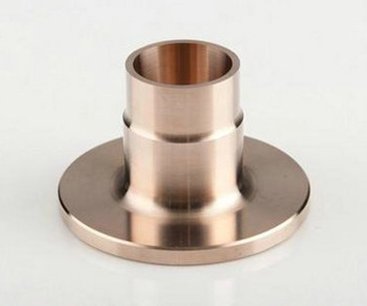
A Copper Nickel Welding Neck Collar is a short, precision-forged and CNC-machined fitting that is welded directly to the end of a CuNi pipe. Its purpose is to provide the wetted, corrosion-resistant sealing face that mates with a separate loose backing flange — often called a Van Stone or Composite Flange assembly. Because only the collar itself needs to be manufactured from expensive Copper-Nickel alloy, while the structural backing flange can be a lower-cost carbon steel or stainless steel casting, this design delivers full corrosion protection at the wetted face without the material cost of a solid CuNi flange. It is, in effect, the most commercially efficient way to specify a corrosion-resistant flanged joint in a Copper-Nickel piping system.
CuNi 90/10 (UNS C70600, CW352H, CuNi10Fe1Mn) is the workhorse alloy for the majority of seawater cooling, ballast and fire-main systems, offering excellent biofouling resistance, good weldability and lower cost. CuNi 70/30 (UNS C71500, CW354H, CuNi30Mn1Fe) steps in where higher flow velocities, elevated temperatures or greater mechanical strength are required — typically in condenser tubing headers, high-velocity seawater lift pumps and naval applications governed by MIL-T-16420. Both grades are readily available as Copper Nickel Welding Neck Collars from Sunflex Metalloy, machined to the exact hub length, bore and face finish specified by the project.
Two standards dominate the specification of marine Copper Nickel Welding Neck Collars: DIN 86037 and EEMUA 145 — both of which define the hub geometry, wall thickness and face preparation for collars used with loose backing flanges in shipbuilding and offshore applications. In parallel, ASME B16.5 governs the flange face dimensions, bolt circle and raised-face height that the collar must mate with. A reputable Copper Nickel Collar Manufacturer will manufacture to whichever combination of these standards the project specification calls for, and should be able to supply drawings cross-referencing DIN 86037 hub dimensions against ASME B16.5 flange classes for procurement teams working across both European and American engineering conventions.
Beyond corrosion resistance, Copper-Nickel alloys possess a unique, well-documented property: they actively resist the settlement of marine organisms such as barnacles, mussels and algae on wetted surfaces. This biofouling resistance arises from the slow, controlled release of cupric ions from the alloy surface, which creates a hostile environment for larval attachment without the need for toxic anti-fouling coatings. For welding neck collars positioned at flanged joints — often a preferred settlement site for fouling organisms due to slight surface irregularities — this self-cleaning property significantly reduces maintenance-driven flow restriction over the life of the piping system, a benefit carbon steel, stainless steel and even some nickel alloys simply cannot replicate.
A welding neck collar is only as reliable as the weld that joins it to the pipe. Copper-Nickel alloys weld readily using gas tungsten arc welding (GTAW/TIG) with matching filler metal, and a well-machined collar hub — with the correct bevel angle and wall thickness transition — minimises the risk of incomplete fusion or porosity at the root. Sunflex Metalloy manufactures every welding neck collar with weld-prep geometry compatible with standard shipyard welding procedures qualified to ASME Section IX, ensuring fabricators can proceed directly to production welding without additional procedure qualification testing in most cases.
Sourcing from an experienced Copper Nickel Collar Manufacturer, Supplier and Exporter in India gives marine and offshore project teams access to consistent quality, full material traceability and export documentation suited to international shipyards. Every Sunflex Metalloy Welding Neck Collar is supplied with an EN 10204 3.1 Mill Test Certificate covering chemical composition, mechanical properties, dimensional inspection and hydrostatic test results — with third-party witness inspection by Lloyd's Register, DNV, ABS or Bureau Veritas available on request for classed vessels and offshore installations.
Copper-Nickel alloys resist seawater corrosion, crevice attack and biofouling far better than most stainless steel grades in stagnant or low-flow seawater conditions, and unlike stainless steel, CuNi does not suffer from chloride-induced pitting or stress corrosion cracking in marine environments.
Yes — this is in fact the most common and cost-effective configuration. The CuNi welding neck collar provides the corrosion-resistant wetted face, while a separate carbon steel loose backing flange (forming a Van Stone / Composite Flange assembly) provides the structural bolting connection, since the backing flange never contacts the seawater.
Sunflex Metalloy manufactures Welding Neck Collars from ½" NB (DN15) up to 48" NB (DN1200), with pressure ratings from Class 150 to Class 2500, and custom sizes on request.
Yes, every Copper Nickel Welding Neck Collar shipped by Sunflex Metalloy includes an EN 10204 3.1 Mill Test Certificate as standard, with 3.2 third-party witnessed certificates available for naval and classed vessel projects.
Our engineering team is available to assist with collar selection, standard interpretation and custom specifications.
Contact Our Team